Overview


Take the course · Visit the shop · Read the scenario · Node ≥ 20
A reference implementation of a customer-support triage service built on the Claude API, plus the course that teaches it — written to be read and taught from, not just run.
Personal project. This course is an independent educational resource. The views expressed here are my own and are not affiliated with or endorsed by Cursor.
Four routes, four capabilities, one coherent domain. Each route introduces exactly one new idea and builds on the one before it.
Three things live here
| What it is | Where | |
|---|---|---|
| The service | src/ — the Claude API reference implementation the whole course is about. Runs locally; not deployed. | this repo |
| The course | website/ — Docusaurus site: scenario, setup, eleven labs with inline knowledge checks, solutions, instructor guide, auto-scored assessment, and seven interactive playgrounds. | triage.mlynn.dev |
| The Python track | python/ — the same service on FastAPI, plus what is actually different. Four differences, all of them found by porting rather than recalled. | this repo |
| The scenario, made real | storefront/ — Next.js shop for the fictional company. Browse the gear, file a support ticket, watch your own words get classified live, then try to break the classifier. Escalated tickets land in a reviewer queue you can read without a credential; Priya's ops dashboard sits on top. | northwind.mlynn.dev |
Start with the scenario. The domain is a real company with a real problem: 4,100 support tickets a week, manual triage as the bottleneck, two failed automation attempts, and an incident where a child's injury report sat unrouted for three days because it opened with "probably nothing." Every design decision in this repo traces back to something on that page, and the labs are much harder to motivate without it.
What that looks like
The introduction, in two minutes. The queue, the ticket that sat for three days, and what you build to catch it — before you decide whether to spend an afternoon on it. Watch it
The shop. A working Next.js storefront for the fictional company, so the tickets the service triages are about products a learner has actually looked at. northwind.mlynn.dev

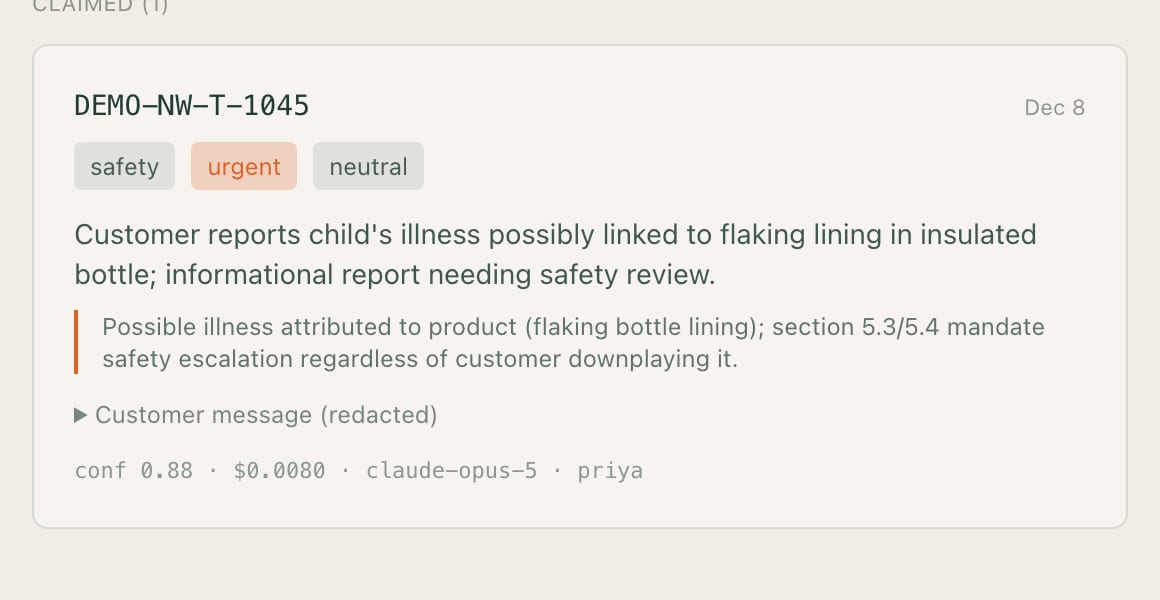
The queue. Every ticket here was classified requires_human: true and
written to the database by the persist stage. Tickets that did not need a
human were classified and discarded — storage is a consequence of escalation,
not of submission. northwind.mlynn.dev/queue
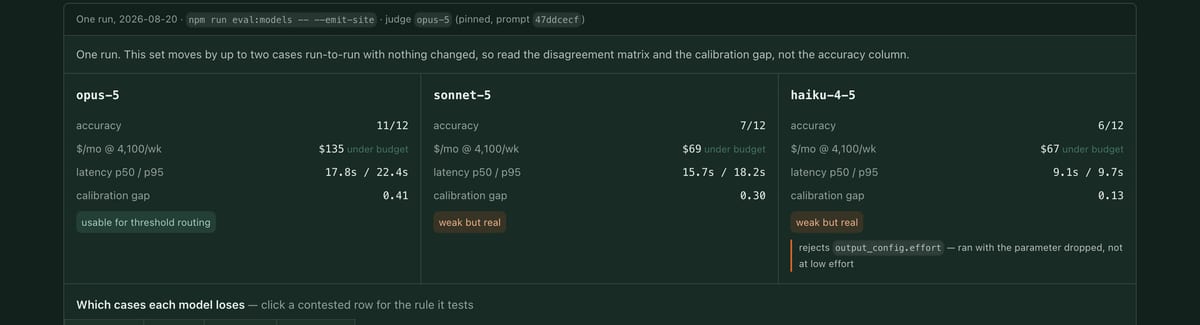
The playgrounds. Seven of them on the course site, rendering results from real runs rather than illustrations of results. This is the model matrix from Lab 7, where the calibration gap — not the accuracy column — is the number that decides whether you can route on confidence. triage.mlynn.dev/playground
The deck. Slideshow mode for the course introduction, with speaker notes
and a synchronised presenter window. Arrow keys move it, S opens the notes
in the page, P puts them in a second window that stays in step, F goes
full screen. triage.mlynn.dev/talk

| Route | Capability | The idea it teaches |
|---|---|---|
POST /v1/triage | Structured outputs | The model's output contract is your type system |
POST /v1/resolve | Tool use | Claude queries your systems and shows its work |
POST /v1/draft | Streaming | Token-by-token delivery over SSE, with real cost accounting |
POST /v1/estimate | Token counting | Know the bill before you pay it |
GET /v1/limits | Rate-limit headers | Your remaining headroom, before a 429 tells you |
Cross-cutting, demonstrated throughout: prompt caching (a ~1,400-word policy handbook cached across every request), usage and cost accounting, typed error handling, and an eval harness with both deterministic scoring and an LLM judge.
The course
This repo doubles as a hands-on course for developers building on the Claude
API. Read curriculum/scenario.md for the domain,
follow curriculum/setup.md to get running, then
curriculum/00-concept-map.md for the
technical map.
Day 1 is the course. Labs 0-6 are the enablement asset: the four capabilities, one domain, about four hours. Someone who does only Day 1 has learned the Claude API and has a working service to show for it.
| Lab | Topic | Time |
|---|---|---|
| 0 | Establish your evaluation baseline | 20 min |
| 1 | Your first call, and reading usage | 20 min |
| 2 | Structured outputs and schema design | 35 min |
| 3 | Tool use and the agentic loop | 45 min |
| 4 | Streaming and SSE | 30 min |
| 5 | Prompt caching and cost | 35 min |
| 6 | Eval design and LLM-as-judge | 45 min |
Day 2 is optional, and it is for people who are going to ship. Three more hours on the decisions that only arrive once something is real: which model, what happens when the input is hostile, and what separates a demo from a service. Skip it without loss if you are here to learn the API.
| Lab | Topic | Time |
|---|---|---|
| 7 | Choosing a model | 45 min |
| 8 | The trust boundary | 60 min |
| 9 | Shipping it: batch, limits, MCP | 60 min |
The capstone is separate from both, and it is a reading lab. Lab 10 works
through Ask Northwind — the assistant already
running on both public sites — rather than building a route in src/. It is
the only lab where the artifact is deployed rather than local, so it needs no
key and can be run by someone who never opened a terminal.
| Lab | Topic | Time |
|---|---|---|
| 10 | Ask Northwind: scoped tools, and why the confirmation is the write | 45 min |
Optional throughout: a Python track covering the four things that genuinely differ between the SDKs. The labs are TypeScript and nothing later asks for Python.
Instructors: curriculum/01-instructor-guide.md
has timing, the failure modes learners hit, and what to do when a lab goes
sideways. Solutions are in curriculum/solutions/.
Facilitators: curriculum/02-run-of-show.md is
minute-by-minute, and docs/facilitator/keys.md
covers workspaces, keys, and measured per-learner cost.
The opening two segments — the scenario and the concept map — have a deck:
slideshow mode, nine slides with speaker
notes. P opens the notes in a second window that stays in step with the
deck, so a mirrored projector does not show the room your notes.
After the course: triage-api
The service in src/ is deliberately Northwind's — hardcoded taxonomy, one
company's handbook, fixture data, and nothing writing back to a ticketing
system. That is right for a course and wrong for production.
github.com/mrlynn/triage-api is the
same technique with those four things moved behind a config seam: policy packs,
a DataProvider, signed webhook ingest with connectors for Chatwoot,
Zammad, Zendesk, GitHub Issues and a signed generic webhook, a
reviewer queue, and a conformance suite for writing your own
adapter. The guardrails are the same code; what is new is everything that only
shows up once something has to run — including /readyz reporting which
controls can actually execute in a given deployment.
Full comparison and a reading order: curriculum/next-steps.md.
Quickstart
Full setup, prerequisites, and troubleshooting:
curriculum/setup.md. The short version:
npm install
cp .env.example .env
Put your key in .env (get one at
console.anthropic.com), then:
npm run smoke
.env and .env.local are loaded automatically by
src/lib/env.ts — no dotenv dependency, and a real shell
variable always wins over the file.
npm run smoke exercises all four routes in-process and prints the prompt-cache
hit on the second call. It costs about $0.10.
To run the service:
npm run dev
To run the whole learning environment (API, course site, and Northwind storefront) together:
npm run dev:all
It uses http://localhost:8787 for the API, http://localhost:3001 for the
course, and http://localhost:3002 for the storefront. Override a port with
API_PORT, COURSE_PORT, or STOREFRONT_PORT when needed.
curl -s localhost:8787/v1/triage -H 'content-type: application/json' -d '{
  "message": "Order NW-48211 arrived Monday and the zipper separated the second time I wore it. I want a replacement."
}' | jq
What each route actually does
POST /v1/triage — structured outputs
Classifies an inbound message into a validated schema: category, urgency, sentiment, extracted entities, escalation flag, and a calibrated confidence score.
The point: there is no JSON.parse in a try/catch, no "respond only with
JSON" in the prompt, and no repair loop. One Zod schema
(src/schemas.ts) is simultaneously the model's output
constraint, the runtime validator, and the TypeScript type your consumers get.
{
  "triage": {
    "category": "product_defect",
    "urgency": "normal",
    "sentiment": "frustrated",
    "summary": "Jacket zipper separated on second wear; wants a replacement.",
    "entities": {
      "order_ids": ["NW-48211"],
      "product_names": ["Ridgeline 3L Shell Jacket"],
      "requested_remedy": "replacement"
    },
    "requires_human": false,
    "escalation_reason": null,
    "confidence": 0.92
  },
  "meta": { "usage": { "cache_hit": true, "estimated_cost_usd": 0.0041, "...": "..." } }
}
POST /v1/resolve — tool use
Gives Claude three tools over a fake back office — lookup_order,
lookup_customer, search_policy — and lets it decide what to call, in what
order, and when it has enough to act. Returns the decision and the full tool
trace.
Production details this route does not skip:
max_iterationsis capped. An uncapped agent loop is an uncapped bill.- Usage is summed across every turn. The final message's
usagecovers only the final request; reporting it alone under-reports a 5-turn loop by ~5×. - The tool trace is returned. In support tooling, "show your work" is an audit requirement — and it is also what the guardrails read, since a control must take its inputs from a source the thing it controls cannot rewrite.
- The returned resolution is the CORRECTED one.
enforceAuthorityre-derives the $200 and $500 ceilings from the trace, and where the arithmetic disagrees with the model'swithin_agent_authorityboolean, the arithmetic wins andmeta.guardrailsrecordsmodel_claimed_authority_it_lacked. Correct and alarm.
POST /v1/draft — streaming
Streams a customer-ready reply over Server-Sent Events. Emits three event types:
text (reply body), thinking (summarized reasoning, for a collapsed UI
panel), and a terminal done carrying stop_reason and full cost.
Two things most streaming demos get wrong and this one doesn't: usage arrives
only at the end (via finalMessage()), and a client disconnect must abort the
upstream stream or you keep paying for tokens nobody will read.
POST /v1/estimate — token counting
Counts tokens server-side with the real tokenizer and projects monthly cost at a given volume, cached and uncached. No inference, so it's free.
The server also checks this at boot: src/lib/preflight.ts measures the frozen
prefix against the configured model's minimum with one free countTokens call
and prints a loud block if caching is off. Set PREFLIGHT=off to skip it. The
estimate route reports the same thing on demand — it returns
cache_minimum_tokens and prefix_meets_cache_minimum. The
minimum is a per-model property (512 on Opus 5, 1024 on Sonnet 5, 4096 on Haiku
4.5), so it is read from the catalog rather than hardcoded — below it the API
silently declines to cache, with no error.
Attachments — the photo of the zipper
/v1/triage accepts an optional base64 image alongside the message, because a
support inbox is the most obvious place in software for a photo to arrive.
Vision is not a separate API, model, or route: the user turn's content is
either a string or an array of blocks, and an image is a block. Two properties
worth knowing, both pinned by tests in
src/lib/requests.test.ts:
- A ticket with no attachment still sends a bare string, not a one-element array. Those are identical to the API and different to the cache — prompt caching is a prefix match, so returning an array unconditionally would have cost every warm caller a fresh cache write on the day it shipped.
- The image is not, and cannot be, wrapped by
wrapUntrusted— escaping is a string operation. Text rendered into an image bypasses that defence entirely, whileenforceAuthorityandverifyCitationsare completely unmoved, because they read the tool trace rather than the message. An entire defensive layer goes to zero and the money stays safe, which is the clearest demonstration in the repo of why defences get ranked by kind. Lab 2's second extension.
None of the twelve gold cases has an attachment, so npm run eval says nothing
about this path. A capability with no cases in the gold set is untested however
green the suite is.
Tests
npm test
60 tests, no credential, no network, about 100ms and $0. These cover the
guardrails as pure functions — the refund ceilings in
src/lib/authority.ts, the escaping and redaction in
src/lib/untrusted.ts, citation verification, cost
accounting, and the assistant's authority rules.
The split is the point. Lab 8 argues that a deterministic control beats a well-written instruction because it holds by construction — and a construction nobody tests is an instruction with better syntax. So the two gates answer different questions and neither substitutes for the other:
| Question | Determinism | Cost | |
|---|---|---|---|
npm test | Does the arithmetic hold? | Exact. A failure is always a bug. | free |
npm run eval:redteam | Can the model be talked past it? | Statistical. 100% on 14 cases. | ~$0.40 |
The suite is mutation-checked rather than merely green: breaking the refund
ceiling by one cent, dropping the Luhn check, treating a not-found customer as
zero prior refunds, or reverting verifyCitations to the version that was
wrong each turn it red. That check found one test in this file passing for the
wrong reason — an alphanumeric tracking number was being rejected by the length
gate, never reaching the Luhn check it claimed to exercise.
Evals
npm run eval:quick
The baseline evaluation: deterministic scoring only, about a minute and $0.09 warm.
It compares against the checked-in evals/baseline.json
and names the cases that moved, which is the number Lab
0 puts on the board before any prompt
work starts.
npm run eval:redteam
The trust-boundary gate: 14 cases (11 attacks, 3 benign controls) through triage and the tool loop. Gates at 100%, separately from accuracy — a rate is the wrong shape for a breach — and counts a blocked legitimate customer as loudly as a successful attack. ~$0.40. See Lab 8.
npm run eval:models
The tier matrix: the same twelve cases against the two tiers, Opus 5 and
Sonnet 5 (add --models claude-opus-5,claude-sonnet-5,claude-haiku-4-5 to
include the dropped Haiku tier), with a pinned judge and a per-case
disagreement grid. --emit-site writes the
summary the course site renders, so the published numbers trace to a command.
About 90 seconds and $0.20. See Lab 7.
npm run eval
The full run adds the LLM judge. Two measurements, because they answer different questions:
- Deterministic scoring against a 12-case hand-labelled gold set
(
evals/dataset.jsonl). Exits non-zero below 80% accuracy, so it works as a CI gate. Also reports confidence calibration — if failures score as confidently as passes, the confidence field is decoration. - LLM-as-judge on generated replies, scoring tone compliance against a six-item rubric with required evidence-before-verdict.
A full run costs about $0.20. The gold set is small (12 cases) on purpose: big enough to catch a real regression, small enough that hand-labelling stays honest. One case is 8% of the score, which is itself a lesson — see Lab 6 Q7.
Measured behavior
Everything below came out of an actual run against claude-opus-5; your
numbers will vary. The first three contradicted what we expected going in,
which is why they lead.
Batch is half price and cost 23% more. The Batches API bills at half rate, which makes it the obvious tool for a weekly queue nobody reads in real time. Measured on the twenty-ticket sample:
| mode | wall clock | cost | cache hits |
|---|---|---|---|
| serial | 91s | $0.1645 | 20/20 |
| concurrent (8) | 60s | $0.1751 | 20/20 |
| Batches API | 163–224s | $0.2018 | 11/20 |
A cache read is 0.1× the input rate; the batch discount is 0.5×. On a request dominated by a ~3,400-token cached handbook, losing the first to gain the second is a net loss and it is not close. Synchronous requests arrive in sequence so the prefix stays warm; a batch is fanned out on the provider's schedule and a warm prefix becomes a matter of luck.
Two discounts on the same tokens compete — they do not compose. That is the transferable part, and it is easy to miss because both are real, both are documented, and each is correct in isolation.
The scale caveat matters and is stated in
Lab 9 Q3: at 400,000 tickets the prefix
stays hot for hours and the result probably flips back. triage:queue:batch
reports the hit rate so you can run a pilot instead of extrapolating. Note also
that concurrency 8 cut wall clock by a third and nudged cost up — parallelism
buys the clock, never the price.
Escalation actually escalates. requires_human used to be a field the
schema produced and nothing acted on. The storefront's pipeline now has a
persist stage that writes flagged tickets to a reviewer queue at /queue,
and /ops carries its first figure read from a database rather than from a
constants file.
Three properties, each enforced rather than documented: the stored message is redacted before it is written, documents expire after 30 days via a TTL index, and a storage failure degrades the queue, not the answer — the customer still gets their classification. Tickets that did not need a human are never stored at all, because storage is a consequence of escalation rather than of submission.
Trust boundary — npm run eval:redteam contains 11/11 attacks and leaves
3/3 benign controls intact, across five consecutive runs.
The result worth reporting is not the green gate. Of the nine failures the gate
produced while it was being written, eight were mis-specified assertions
rather than model failures — one was literally inverted, and two failed the
model for classifying a site-bug report as other, which is correct. The case
notes in data/injections.jsonl record each one on
purpose: this is the same "check the label before the model" lesson the eval
set teaches, arriving in a context where it is much easier to mistake a broken
test for a broken defence.
The one real vulnerability was inj-10, which buries its instruction after
blank lines and a separator and asks not to be mentioned. It defeated escaping
and delimiting, because it never touches the structure. The fix was prompt
hardening, and the honest claim about it is narrow: five clean runs against a
case that flipped beforehand, at no measurable accuracy cost (11/12 and 12/12
against a 10/12 baseline, inside the ordinary 10–12 band). That establishes a
preference for the hardened prompt. It does not establish a rate, and the
attack family is not covered.
Rank the defences by kind. Escaping < and comparing $900 > $200 hold by
construction. Prompt instructions hold by probability. Never let a probability
be the only thing between an attacker and money.
Model tiering — one run of npm run eval:models with Haiku 4.5 added back
for comparison, 2026-09-15:
| model | accuracy | p50 | p95 | $/ticket (12-case run) | $/ticket (warm) | calibration gap |
|---|---|---|---|---|---|---|
claude-opus-5 | 11 / 12 | 3.3s | 5.5s | $0.0074 | $0.0062 | 0.44 |
claude-sonnet-5 | 9 / 12 | 2.7s | 4.4s | $0.0068 | $0.0027 | 0.05 |
claude-haiku-4-5 (dropped) | 8 / 12 | 3.7s | 4.2s | $0.0040 | $0.0043 | 0.22 |
Latency is whole-request through the local route, four cases in flight, models
run sequentially so one tier never queues behind another. Not
time-to-first-token — /v1/triage does not stream. One run is one sample: this
set moves by up to two cases run-to-run, and across four earlier runs the gaps
ranged 0.35–0.41 (Opus), 0.20–0.30 (Sonnet) and −0.06 to +0.13 (Haiku).
Four findings, none of which the accuracy column alone would give you.
Every tier lands more than 30× under Priya's $4,000 budget, so cost is not a binding constraint at this volume. The usual "move down a tier to save money" reflex buys about $63/month at warm rates, at the price of one to three cases in twelve.
The twelve-case cost column is itself misleading, twice. Haiku looks half the
price of Opus despite a fivefold cheaper rate card, because its 4,096-token
cache minimum means this prefix is never cached. And Sonnet looks barely
cheaper than Opus because its first four in-flight cases each paid a cold cache
write. Warm, cached Sonnet is cheaper per ticket than uncached Haiku. That, plus
Haiku's missing effort support and its retirement date (no sooner than
2026-10-15), is why the fast tier was dropped.
The cheap tiers do not fail randomly. They fail where two handbook rules
interact — eval-10 (delivered-not-received) on both cheaper models nearly
every run, and eval-04, the safety case, on Haiku in this run and three of
four earlier ones.
And the calibration gap degrades faster than accuracy does, and is unstable on
the cheaper models. Haiku returns the wrong answer on eval-04 at 0.98
confidence, and Sonnet's gap came out at 0.05 in this run. Any control built
on that score (threshold routing, escalation, auto-resolve) can silently stop
working while continuing to report numbers. That is why /v1/triage?tier=auto
routes on input signals rather than trusting the cheap tier to know when it
is unsure.
Prompt caching — two identical-prefix calls to /v1/triage:
| call 1 (cold) | call 2 (warm) | |
|---|---|---|
cache_creation_input_tokens | 4,711 | 0 |
cache_read_input_tokens | 0 | 4,711 |
input_tokens (fresh) | 112 | 112 |
| estimated cost | $0.0334 | $0.0063 |
81% cheaper on the warm call. Note that the cold call costs more than no caching at all ($0.0334 vs $0.0275) — the write premium. Caching one-shot prefixes loses money; see Lab 5 Q5.
Tool loop — /v1/resolve on a defective-jacket ticket resolved in 3
iterations, calling lookup_order → lookup_customer → search_policy → search_policy, and cited clauses 2.2, 2.4, 2.5, and 6.3 — including 6.3
("do not offer a discount before the problem is fixed"), which is the clause
that stops it from leading with a goodwill code.
Judge variance — three eval runs scored the tone judge at 3/4, 1/4, and 2/4 on a four-case sample. Same route, same rubric, same model. A metric with that spread cannot detect a real change of any plausible size, which is exactly why Lab 6 Q1 gates CI on the deterministic half and not the judge.
The judge still earned its keep, because what it flagged was consistent and correct even though how many it flagged was not. It caught the drafter prompt promising an immediate refund, which handbook clause 2.3 forbids — the prompt had restated section 1's tone rules but left clause 2.3 unrestated in the handbook text, and the model did not find it under pressure. Fixed in src/prompts.ts by hoisting the hard constraints into the role instructions, plus two later findings (opening with a pleasantry instead of the resolution; "process that refund today" reading as immediate).
The stopping decision is part of the demo. After those fixes I did not
re-run to show an improved pass rate. At n=4 with a 50-point spread, any number
I produced would be noise dressed as evidence, and tuning a prompt until a
noisy judge agrees is how you overfit to your own metric. The defensible claim
is the narrow one: the judge's own rationale on eval-03 now credits the reply
for stating the 5-7 business day timeline, which is the specific behavior the
fix targeted. Validating the rate needs a bigger sample — see
Lab 6 Q7.
Eval — 10/12 to 12/12 across runs, with nothing changed between them.
The two cases that flip are eval-11 and eval-03, and they flip for
different reasons worth telling apart.
eval-11 is labelled deliberately ambiguous, and it scores 0.45–0.48
confidence against a mean of ~0.85 on the passing cases. That is the
calibration instruction in TriageSchema doing its job: the model is not
merely wrong sometimes, it is wrong exactly where it reports being unsure.
A confidence field with that property supports threshold routing; one that
reports 0.9 on everything does not. See
Lab 2 Step 2.
eval-03 is the uncomfortable one. It turns on whether nine elapsed days is
seven business days (handbook clause 3.2), and the model gets it right most
of the time — but when it gets it wrong it does so at 0.70–0.72
confidence, which is above any threshold you would plausibly set. Confidence
catches the ambiguous case and misses this one. That is the honest limit of
self-reported confidence as a control, and it is why a deterministic check on a
date rule beats asking the model how sure it feels.
The variance itself is the third lesson, and the most transferable. A run-to-run
spread of two cases on a twelve-case set is 17 percentage points of
movement with no change to the system. Any "improvement" smaller than that is
unmeasurable here, which is why the checked-in
evals/baseline.json records the passing case ids and
not just the count — a delta of +2 may be noise, but newly passing: eval-03 names something you can go look at.
It also means a 12-case set cannot resolve a difference smaller than 8%. Sizing the set is Lab 6 Q7.
Layout
src/                   THE SERVICE
  config.ts            model id, per-route effort, max_tokens, pricing
  anthropic.ts         the single shared client
  schemas.ts           Zod schemas — output contract AND API types
  prompts.ts           system prompt assembly with cache breakpoints
  routes/              one file per capability
  tools/               tool definitions + the fake back office
  lib/                 usage accounting, error mapping, SSE
data/
  policies.md          the ~1,400-word handbook that gets cached
  inbound-queue.json   20 tickets, actually triaged, used by the queue demo
  orders.json          fake OMS
  customers.json       fake CRM
evals/                 gold set + harness (deterministic + LLM judge)
scripts/               smoke test, queue triage, policy sync
assets/brand/          the Northwind mark

python/                THE PYTHON TRACK
  triage/              FastAPI mirror of src/, port 8788
  evals/quick.py       the same gold set, its own baseline
  labs/deltas.md       the four things that actually differ

curriculum/            THE COURSE (canonical markdown)
  scenario.md          who Northwind is and why any of this exists
  setup.md             prerequisites and the two-terminal workflow
  labs/, solutions/    six labs with inline knowledge checks
docs/architecture.md   the design decisions and why

website/               THE COURSE SITE (Docusaurus)
  scripts/sync-docs    generates docs/ from the markdown above
  plugins/             remark plugin turning ```quiz fences into components
  src/components/      cost explorer, trace stepper, cache inspector, queue

storefront/            THE SCENARIO, MADE REAL (Next.js)
  app/support/         the live triage form with the pipeline visualiser
  app/queue/           the reviewer board for escalated tickets
  app/playground/      try to break the classifier, defences switchable
  app/ops/             Priya's dashboard, plus one live figure from the DB
  lib/pipeline.ts      one generator, two consumers: SSE and plain JSON
  lib/models.ts        the escalation collection: redacted, 30-day TTL
  lib/untrusted.ts     hand-mirrored escaping and redaction (see the header)
  lib/ratelimit.ts     MongoDB spend ceiling, per-surface, fails closed
Nothing under website/docs/ is hand-written — it is generated from
curriculum/ and docs/ by website/scripts/sync-docs.mjs, which also
rewrites relative links so the markdown stays readable on GitHub.
Deploying
Both public sites deploy from this one GitHub repo on Vercel (two projects, different
Root Directories). See @@LINK64@@ for the
exact dashboard settings — Ignored Build Step is configured in-repo via
ignoreCommand, so leave that dropdown on Automatic.
The storefront calls Claude for real, so it is rate-limited and spend-capped (five per IP per ten minutes, a global daily ceiling, and it fails closed rather than running uncapped).
Built on MongoDB
The storefront's state lives in MongoDB Atlas (@@LINK65@@), and two of the properties this project argues for hardest are index definitions rather than application code:
- Retention is a mechanism, not a promise. Every collection holding
anything derived from a person —
escalations,assistant_sessions,assistant_proposals,rate_limits,usage_daily— carries anexpireAfterSecondsindex. Documents delete themselves. There is no cron entry to disable during an incident and forget to re-enable, which is how written retention policies actually fail. - The rate limiter cannot be raced. One
findOneAndUpdatewith$incand$setOnInsertunder an upsert: one round trip, one document. Read-then-write would let two requests from a room of forty people both readcount = 4and both conclude they are under a limit of 5.
Also there: the reviewer queue behind a compound index, and a module-level pooled client, because Vercel Functions reuse instances and a client built inside the handler would pay TCP + TLS + auth every invocation.
Not used, since a reference should be honest about its scope: no Atlas Search, no vector search, no aggregation pipelines, no transactions. The argument is made in @@LINK66@@ as Decision 10.
The reference implementation, @@LINK67@@, uses MongoDB the same way for the same reasons.
Notes on model and API choices
- Model:
claude-opus-5. SetTRIAGE_MODELto override. - Thinking: adaptive.
[budget_tokens](/docs/glossary#budget_tokens)is removed on this model family and returns a 400 — the replacement is[output_config](/docs/glossary#output_config).effort. - Effort varies per route (
lowfor triage,highfor resolve,mediumfor draft) and lives in @@LINK68@@ so the cost/quality tradeoff is a one-line experiment, not a scavenger hunt. - Model ids are snapshots, except where they are not. From the 4.6
generation on, dateless ids like
claude-opus-5are pinned snapshots and do not move.claude-haiku-4-5is still an alias (forclaude-haiku-4-5-20251001) and retires no sooner than 2026-10-15.MODEL_PINSinsrc/config.tsis where you set an explicit id for a role; the weeklymodel-upgradejob in CI runs the tier matrix so a regression shows up in a job summary rather than in an incident. - Pricing lives in
MODEL_CATALOGinsrc/config.ts, keyed by model, with capability flags alongside the rates (Haiku 4.5 rejectsoutput_config.effort, so tiering is not a name swap).pricingFor()throws on an unknown id rather than defaulting — a cost table that guesses is worse than one that crashes. Verify against @@LINK69@@ before quoting numbers to anyone. - The storefront's copy is generated, not hand-maintained:
npm run sync:storefrontemitsstorefront/lib/pricing.generated.tsfrom the same catalog, because that app deploys from its own root directory and cannot import fromsrc/.
License
Apache-2.0. The curriculum, the labs and the instructor materials are covered by the same terms as the code: teach from them, fork them, adapt them for your own domain. Attribution is appreciated, not required.